Agile might be one of the most overused words in business: it’s splashed around so often that in certain circles, what it actually means often gets lost. At IIG, and in most technology businesses, however, it applies to a fairly strict understanding of software development. To many of us, it brings to mind first and foremost the ceremonies: Sprint Planning, Daily Stand-Up, Sprint Review and Sprint Retrospective.

But how much thought do we really put into the reasons and values behind the agile processes? Are we considering how it applies to our own individual thoughts, actions, and attitudes towards our colleagues and our work?
Building a truly Agile Mindset within teams encourages practitioners to maintain a clear sight of the value they are trying to achieve. More than just solving immediate problems, it enables teams to realise their full potential, through a completely optimised approach. In short, they will be fully empowered to do the right thing at every opportunity.
What is an Agile Mindset?
Yes, it can sound a bit culty: but it might be better to think of the mindset as a way of ensuring that we actually follow through on the values behind the processes.
Almost everyone reading this will know these values, but just in case they’ve slipped your mind:
- Individuals and interactions over processes and tools
- Working software over comprehensive documentation
- Customer collaboration over contract negotiation
- Responding to change over following a plan
These are defined by a following twelve principles, which then flow out into an unlimited number of practices. Practices are the manifestation of working towards agile values, and provide fantastic training wheels to start your team on an Agile path. But what they actually are matters least of all. It’s the motivation behind them that really counts.

Forgetting the practices and frameworks for a minute, and instead focussing on shaping our working thinking and behaviours around these values, is what will make us truly agile. It allows the practices we do adopt to continually work as well as possible, without being held back by contradictory behaviours, or anti-patterns.
Why do we need it?
Adopting the right mindset means we are personally, individually focussed on learning, experimentation, and continuous improvement. The flexibility at the heart of Agile simply won’t flow through if part of us is thinking in terms of old school team hierarchies, rigid processes, a strict plan and a fixed idea of what’s needed.
These ideas, from the old Victorian way of managing factories, that had less to do with skill than it did with management, are inculcated in us from the minute we join school. We can’t help it if they’ve wormed their way into our brains. To root them out, we need to challenge ourselves in terms of what’s drives us forward.

Doing so means that not only is our organisation more adaptable to change – but so are we, as individuals. We, personally, can keep learning, bounce back from mistakes, flex to change. We can value, and be valued by, our colleagues for their myriad contributions, not their position on an org chart. We can produce more, better work, that excites and progresses our customers.
Individual reasons for adopting an Agile mindset can vary, from a desire to manage risk effectively, a preference for non-hierarchical working, to a straightforward need to beat competition. This means that there will always be different interpretations of what the ‘Most Agile’ thing to do is (although thinking that way is also dangerous). But at least we will be able to trust that our essential priorities are the same.
How do we translate that behaviourally?
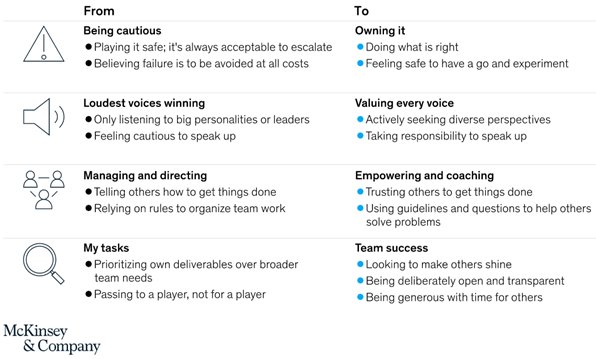
A recent McKinsey article focussed on doing, rather than being: i.e. that action matters more than just saying While the article focusses more on top-down culture, it does include some really excellent examples of transformative behaviours.
It’s likely that many of us are, inadvertently, undertaking actions that fall into the ‘From’ column from time to time. It’s important to challenge ourselves, and consider why: it’s not enough just to be Agile for the sake of it.
Choosing the best practices
We do the Agile practices to ensure values are delivered throughout our work – but that doesn’t necessarily mean we’re following through on them. For instance, doing sprints every two weeks enables you to ensure you’re staying on track with customer needs; it should put interactions and individuals over processes and tools. But are those meetings being run collaboratively, or is there a hierarchy? Is everyone encouraged to speak openly, or is there a tone of criticism that dissuades transparency?
Sprint reviews aim to demonstrates that software is working; meeting with the customer encourages collaboration. But are all team members taking feedback onboard in the spirit it’s being given? Or is there a feeling within the team that engineers know what the customer needs better than they do? Taking the time to think through what’s really driving us, and whether we are utilising Agile practices with the right aim behind them, can help to make the most of their advantages.
Individual ownership
For an Agile mindset to flow through our teams and permeate our business culture, we need to drive it through our behaviour, through empowerment from the top, and collaborative growth from the bottom up. We need to take the time to reconsider our behaviours: this doesn’t mean constantly criticising ourselves, but it does mean thinking twice. Are you working in the spirit of Agile – or are you just following the letter of the law?

 Grace Thiele