CACI takes a zero-tolerance approach to slavery and human trafficking within our business and supply chain. CACI comply with the Modern Slavery Act 2015 by publishing an annual Modern Slavery statement in compliance with its obligation under Section 54(1) of the MSA 2015. This statement is approved annually by CACI’s board of directors and can be found on the CACI website.
Understanding of Modern Slavery Risks and Issues Affecting the Market
CACI understands that the term ‘modern slavery’ covers four distinct forms:
- Human trafficking
- Forced/compulsory labour
- Bonded labour
- Slavery.
Our supply chain includes large multinational hardware, software and/or data suppliers, professional services and utilities providers and facilities contractors. Most are UK-based and our foreign-based suppliers operate within the high-end IT professional services.
The highest risks of modern slavery apply to residents of regions that are fragile and conflict-affected, suffering from gaps in law and enforcement on modern slavery, high levels of corruption, and where specific groups lack basic protection under the law. Additional risk applies to worksites with large numbers of internal/foreign migrant workers, refugees, low skilled/informal workers, women, and temporary/agency/contract/seasonal workers.
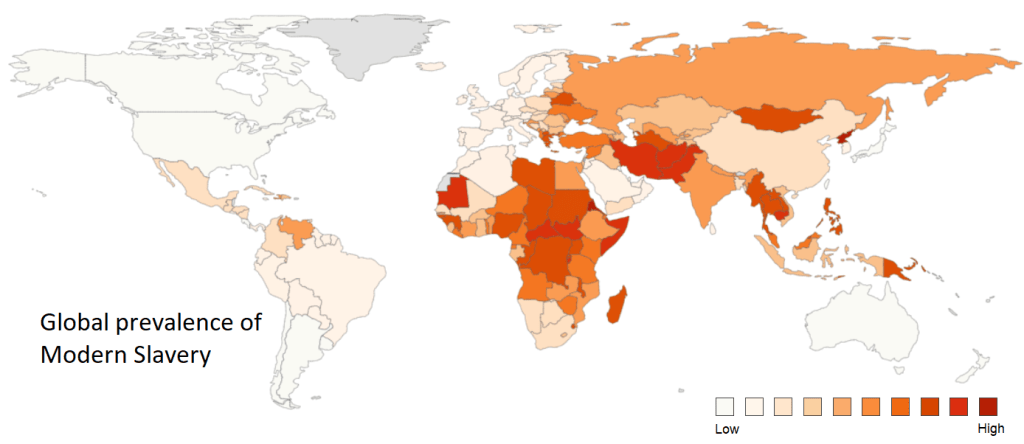
Figure 1 – Global Slavery Index
Therefore, the risk to CACI’s workforce is relatively slim. However, the International Labour Organization (ILO) estimates that globally at least 40.3 million men, women and children are in some form of slavery. In the UK, that figure is estimated at 10-13,000 people.
We also appreciate that other serious labour abuses, that may not constitute slavery on their own, contribute toward comparable conditions. For instance, delayed payment of wages, excessive working hours or verbal threats.
Indicators are multitudinous, but include:
- Coercive recruitment (abduction, confinement during recruitment)
- Recruitment linked to debt
- Deception about the nature of the work
- Confiscation of identity papers or travel documents
- Limited freedom of movement and communication
- Multiple dependencies on employer (e.g. accommodation, food, travel and work).
CACI understands the business implications of failing to manage modern slavery risks, as well as the positive effects, including reduced business risk, continuity of operations, access to markets and increased worker productivity.
Mapping Company Supply Chains
We have a responsibility to exert our influence on our supply chain to eliminate modern slavery. Although CACI tracks and monitors immediate suppliers through our Supplier Questionnaire and other measures, it can be challenging to maintain visibility further down the chain. Unfortunately, working conditions in the broader network of our supply chain, where there is more likely to be a vulnerable workforce, are not necessarily immediately visible to us.
Measures to Identify, Mitigate and Manage Modern Slavery Risks
- Training and Awareness: We provide training on an annual basis to all staff to ensure a high level of understanding of the risks of modern slavery and human trafficking, both in our supply chain and business
- Our supply chain consists of over 500 diverse suppliers, for example, large multi-national hardware, software and/or data suppliers, professional services providers, utilities providers and facilities contractors. We review our suppliers across the spectrum and conduct an annual assessment of our supply chain by sending out an anti-slavery questionnaire to all relevant suppliers. This includes questions around review of their supply chain, and employee/contractor wages. We then review and record all responses. Should any concerns be identified these are dealt with via the appropriate channels
- Every six months, we require our suppliers to participate in a Compliance Review, where they present their supply chain to us alongside the management measures they are taking. We respond with improvement steps, which we expect to have been undertaken by the next session.
- Clear Escalation Path: CACI has an internal legal team of six lawyers, who advise the business on the Modern Slavery Act (MSA). CACI have a number of policies/mechanisms in place to ensure that both employees and contract staff have the necessary mechanisms to report any incidents or concerns:
- Recruitment Policy, including Pre-Employment Checks
- Whistleblowing Policy
- Grievance Policy
- Annual Staff Satisfaction Survey
- Mental Health First Aiders
- Career Coaches
Our Modern Slavery Policy outlines our commitment to ensuring there is transparency in our own business and in our approach to tackling modern slavery throughout our supply chains, consistent with our disclosure obligations under the Modern Slavery Act 2015. It outlines the responsibilities of staff and managers and ‘What to look out for’, to promote staff awareness:
- Supplier deliberately not responding to the CACI anti-slavery risk assessment questionnaire or responds with answers that causes suspicion of wrongdoing
- Supplier that has a turnover of £36m or more failing to file a Modern Slavery Statement on the Home Office’s website (https://modern-slavery-statement-registry.service.gov.uk/search)
- Supplier not agreeing to an unannounced audit/inspection
- Supplier reducing its price to an unrealistic level
- Media/Reports: referring to rogue suppliers (of course media reports are not always accurate)
- Suppliers’ staff saying things which may indicate slavery (e.g. that their employer keeps their passport).
 Grace Thiele